
Data & Biospecimens
Collecting Data and Biospecimens to Reveal Insights
Simons Searchlight advances understanding of rare genetic neurodevelopmental disorders by collecting high-quality data and biospecimens, expertly curating and securely sharing these resources with researchers, and fostering strong partnerships among scientists, families, and patient advocacy organizations.
A central part of our work is collecting two types of research information from participants: long-term health information and optional blood samples. Health information is collected through surveys over time to better understand how conditions change, while blood samples are typically collected once, processed into research biospecimens, securely stored in a biobank, and made available to qualified researchers.
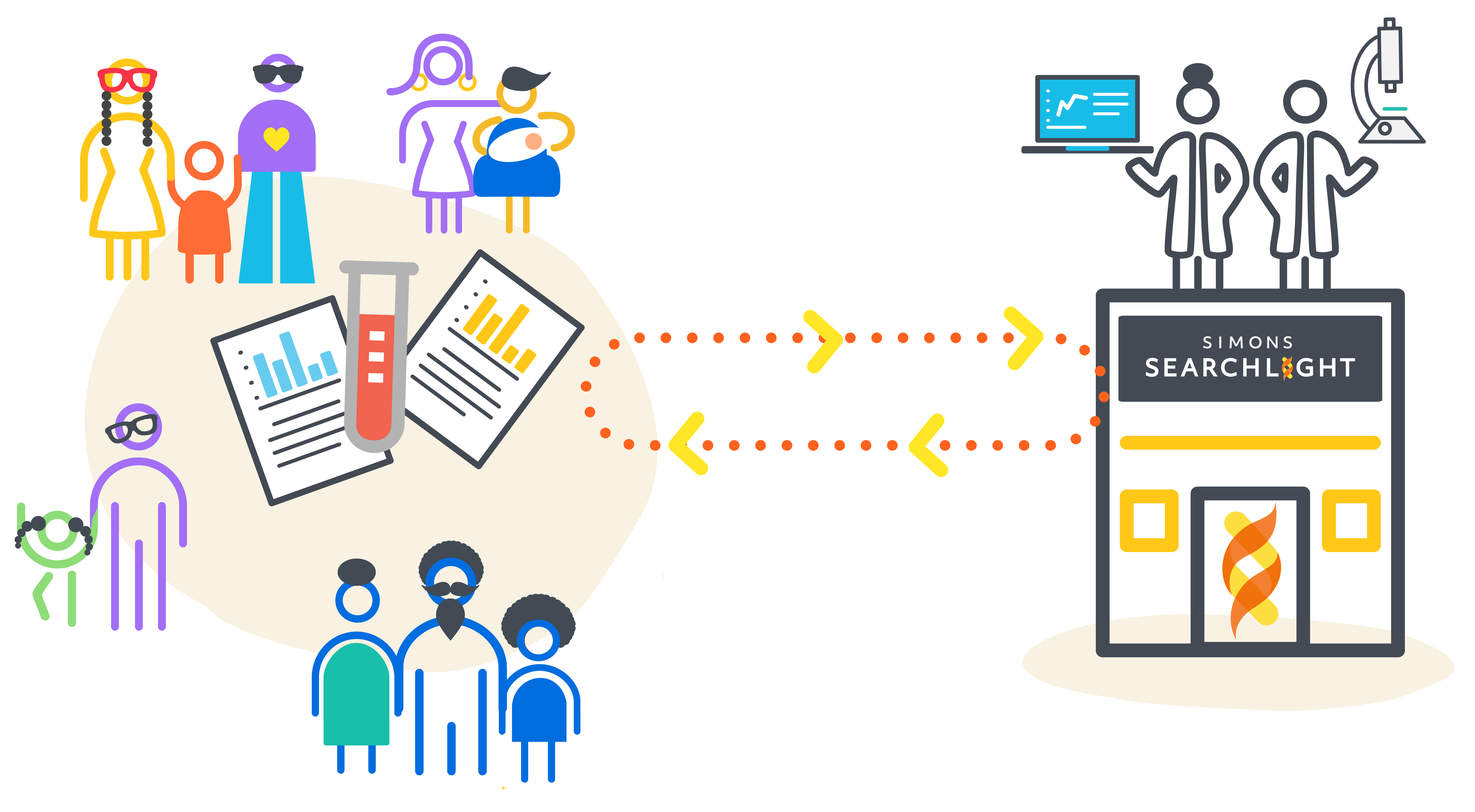
This work involves:
- Surveys and targeted phone follow-ups about your medical history and behaviors. This gives us a full picture of your experiences.
- Periodic updates about your symptoms and quality of life. These long-term data help researchers understand how your health changes over time.
- Optional blood samples are typically collected once to generate research biospecimens (such as DNA, plasma, PBMCs, and iPSCs). Unlike surveys and follow-up information, blood samples are not routinely collected over time to measure changes in health. Instead, they are securely stored in our biobank and made available to qualified researchers.
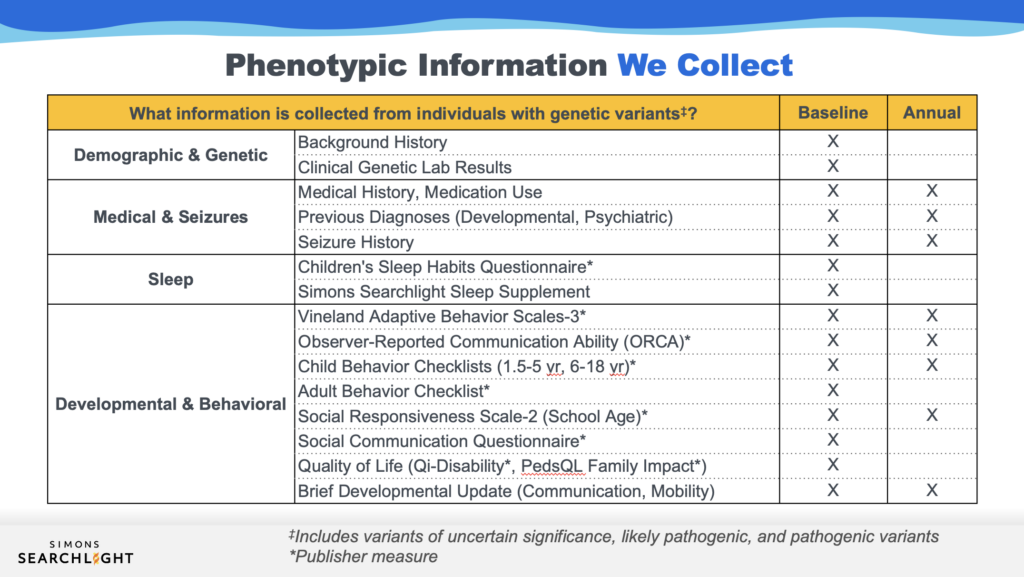
The table below displays the data we collect through the Simons Searchlight surveys.
Donating Blood Samples to Advance Research
As part of Simons Searchlight, families have the option to donate blood samples for research. This helps scientists learn more about your rare genetic condition.
There are two ways families can donate blood:
- At local Quest Labs in the United States
- For participants in the United States, Simons Searchlight offers blood collection through Quest Diagnostics locations nationwide. In some cases, eligible participants may also have the option of an in-home blood draw through TravaLab.
- At this time, our blood collection program is primarily available within the United States because we do not yet have a standardized process for coordinating phlebotomy and specimen shipping internationally. However, we are actively exploring solutions to expand access for participants around the world. Families outside the U.S. who are interested in providing a blood sample are encouraged to contact our team. We review international blood donation opportunities on a case-by-case basis and are happy to discuss potential options. Please email us at Coordinator@SimonsSearchlight.org.
- At in-person patient advocacy meetings where international families can also donate blood
We ask families to donate blood samples to generate biospecimens that will be available to qualified scientists, working on understanding of rare genetic neurodevelopmental disorders.
Research works better when scientists have a variety of samples that span the different genes and variants to study. The more samples they get, the more they can learn about how genetics influence health in rare diseases. Because most participants have a unique variant in their gene, it is important to make sure that your specific variant is available for research – don’t be left behind.
Blood samples from families allow researchers to:
- Compare samples to see differences between people with and without a condition – this helps them spot important patterns.
- Test new technologies for analyzing samples – this leads to new insights over time.
- Accelerate discoveries by facilitating collaboration. Researchers can come together using shared samples, investigate across several conditions, and combine expertise to find answers quickly.
The knowledge gained from blood samples benefits families too. Researchers and doctors take what they learn and develop better treatments and diagnosis methods.
We know that providing samples takes time and effort. Please know that your donation makes a real difference in advancing research on rare disorders. Below are two graphics that outline more information about the Simons Searchlight blood sample collection process.

How are Blood Samples Used in Simons Searchlight??
Blood samples donated to Simons Searchlight can be processed into different types of biospecimens that researchers can use to study rare genetic conditions. These resources may include DNA, peripheral blood mononuclear cells (PBMCs), lymphoblastoid cell lines, plasma, and induced pluripotent stem cells (iPSCs) created from selected blood samples.
Researchers use these different resources depending on the scientific questions they are studying. For recently collected blood samples, plasma produced during PBMC processing is also being made available to researchers.
What are induced pluripotent stem cells (iPSCs), and why are they important for research?
Some donated blood samples can be used to create induced pluripotent stem cells, or iPSCs. Scientists create iPSCs by reprogramming blood cells so they behave more like early-stage stem cells. These cells can then be developed into many different cell types, including brain, heart, and liver cells.
This gives researchers an important way to study how cells from people with specific genetic conditions may function differently and to better understand the biology behind those conditions.
How can iPSCs support research?
iPSCs can be valuable tools for disease modeling and for exploring potential drugs and treatments.
- Understanding disease biology: Researchers can turn iPSCs into cell types such as brain cells and study how genetic changes affect how those cells develop and function. This can help researchers better understand the underlying biology of a condition.
- Exploring potential treatments: Researchers can use cells made from iPSCs to study how they respond to potential treatments, including testing existing drugs for new uses, sometimes called drug repurposing. These laboratory studies can provide important early evidence as researchers explore which approaches may be worth studying further.
Because creating and distributing iPSCs requires specialized expertise and resources, not every donated blood sample is made into an iPSC line. SFARI manages programs that help researchers access available Simons Searchlight PBMCs and iPSC lines and support the targeted creation of new iPSCs based on scientific need and researcher interest.

Simons Searchlight PBMC and iPSC Resources
The Simons Foundation Autism Research Initiative (SFARI) manages programs that make Simons Searchlight biospecimens available to the research community and support the creation and distribution of induced pluripotent stem cells (iPSCs). As part of an initial iPSC effort, SFARI partnered with The New York Stem Cell Foundation (NYSCF) to generate 300 iPSC lines using Simons Searchlight samples. This includes 200 lines from individuals with rare genetic conditions and 100 lines from unaffected, sex-matched family members. These lines are available as a shared resource for researchers studying disease biology and potential treatments.
The SFARI Base webpage includes information about this effort and the status of individual cell lines.
You can also learn more about available iPSCs on the SFARI website.
How can researchers access samples or support new iPSC creation?
SFARI is now expanding beyond the initial NYSCF iPSC effort through two approaches that give researchers a more active role in selecting samples based on their scientific needs:
There are several ways samples may be prioritized or selected:
- Request Simons Searchlight PBMCs for researcher-led iPSC creation: Researchers can request available peripheral blood mononuclear cell (PBMC) samples through SFARI Base and select samples most relevant to their research. SFARI staff scientists review requests based on factors such as funding, reprogramming expertise or an appropriate stem cell partner, and plans for quality control. Researchers who generate iPSCs from these samples must return the resulting lines and quality control data to SFARI’s biorepository so they can be shared with the broader research community.
- Nominate samples for SFARI-funded iPSC creation: Beginning in 2026, SFARI will also launch a Request for Nominations (RfN) that allows researchers to nominate existing, already-collected samples and genetic variants for iPSC generation. Researchers submitting nominations must plan to use the resulting iPSCs in their experiments. SFARI will review nominations based on scientific rationale and alignment with its scientific mission; nomination does not guarantee selection for reprogramming. Through the new RfN program, SFARI and the Nancy Lurie Marks Family Foundation (NLMFF) plan to fund up to 60 new iPSC lines per year. Information on the RfN is coming soon.
Across these approaches, SFARI will continue to host, maintain, and distribute resulting iPSC lines through its biorepository, helping make these resources broadly available to the research community.
Sharing Back With Researchers and Participants
Our main goal is to speed up research and create knowledge that matters to you. Your information makes new discoveries possible, but discoveries don’t help anyone if they’re not shared. We want you, your family, and scientists to benefit from what we collect and learn.
Here is how we share data and biospecimens:
- We provide data and biospecimens (with your identifying information removed) to researchers worldwide through a secure website called SFARI Base, managed by the Simons Foundation. This allows more scientists to access the data, speeding up new discoveries.
- Researchers can submit an order for iPSC lines or request phenotypic or genetic data linked to individual iPSC lines after creating an account with SFARI Base and following the steps outlined in the system. Read more about iPSCs on the SFARI website.
- We share summarized clinical data and new findings with the families through conferences, webinars, quarterly reports, and personalized results about you and your genetic community on your dashboard. This keeps your community engaged and informed.
- We connect you with medical experts like genetic counselors who can explain your results. Knowledge is more empowering when you have support.
Our research model puts you at the center. We prioritize research questions that matter most to you and your family. The information we look for is driven by real needs.
By contributing data over time, you become an active partner in making new discoveries about your condition. By working together, we can transform limited knowledge into meaningful discoveries that benefit you, your family, and future families.
Relevant resources:
- Learn more about SFARI Base and how researchers request participant data
- Simons Searchlight Values Collaborations to Advance Research
- Researchers Using Simons Searchlight Data
Questions?
It is likely that you have questions about taking part in research. Please reach out to us anytime! Our Simons Searchlight team is happy to help.
- Email: coordinator@simonssearchlight.org
- Phone: 1-855-329-5638
FAQs
What role can PAGs play in helping prioritize variants for research?
PAGs can partner with investigators to encourage them to submit a RfN for generating iPSCs or to request PBMCs for iPSC generation in their own labs. PAGs may not submit RfN applications or requests for PBMCs directly.