
An Answer About Autism Leads to a New Research Journey
By Marina Sarris, SPARK
When Franklin Henry was growing up, his parents took him from specialist to specialist. They wanted to understand why he was late to talk, walk, and meet other milestones of childhood. They wanted to help.
Franklin collected an array of “disorder” diagnoses: autism spectrum, oppositional defiant, bipolar, and Tourette.
Except for autism, those diagnoses would often be discarded by the next doctor he saw. One doctor, at Oregon Health and Science University, said, half-jokingly, that what Franklin Henry really had was “Franklin Henry syndrome.” What he meant was that Franklin has something rare and perhaps unique to him, recalls his father, Joe Henry.
When Franklin was 25, the family learned the real name of “Franklin Henry syndrome.” The SPARK autism study told them that Franklin has a variation in an NR4A2 gene. This variant causes NR4A2-related syndrome, which often affects learning, speech, language, sleep, movement, and development. And it is very rare.
But that’s not the end of the Henrys’ journey to understanding.
Now the family is travelling a new path. Joe has contacted researchers and contributed to studies of NR4A2. He also joined the community advisory committee of Simons Searchlight, an online international research program for rare genetic neurodevelopmental conditions, including NR4A2.
He doesn’t just want to help his son and others like him. He believes that research may also unlock clues to treating more common conditions, such as Parkinson’s disease, that scientists believe are related to that same gene.
“What I want families to know is that participating in research can open doors you never knew existed,” Joe says.
Franklin in the Community
Today, Franklin is 29 and a friendly presence in his community in southern Oregon. He spends many of his days doing two things a doctor once predicted he would not do: walking and talking, Joe says. Franklin takes long walks and chats with people he passes along the way. As a youngster, he had significant delays in his speech and motor skills, which prompted the doctor’s prediction.
On Sundays, he watches three services at different local churches. He also enjoys talking on the phone. He calls widows to check in on them. He calls or emails city employees, businesses, and local news outlets to talk about new restaurants or buildings under construction. He watches government meetings online or on TV to learn what’s happening.
“We’re getting a new Dave’s Hot Chicken in town,” his father says. “Franklin will tell everybody about it, and call up the general contractor and ask them when it’s going to be done.”
Franklin says his favorite restaurant is P.F. Chang’s, where he orders the lettuce wraps.
“Franklin struggles with repetitive speech and getting stuck on certain thoughts or topics,” Joe says. When he’s really interested in something, Franklin may call or email about it a lot, his father says. People in his community are understanding.
Unfortunately, not everyone means well. On one of his evening walks, Franklin was assaulted by three 14-year-olds. True to his kind nature, Franklin forgave the teens who hit him, Joe says. “Franklin wanted to take the kids who beat him up to lunch.”
A Close Family
The Henrys are a close family. “The real hero of our family is my wife, Karen, who is Franklin’s primary caregiver,” Joe says. Karen homeschooled Franklin and his younger brother. Franklin also received speech therapy and other services at a public charter school.
When Franklin was 14, he and his father shared a hobby: collecting pennies. “When I was a child I liked looking through Lincoln pennies to find the oddities and rarities,” says Joe, “so I thought maybe Franklin would like to look for things too.”
Franklin enjoyed opening rolls of pennies and searching for pre-1982 pennies, which were made mostly of valuable copper. Joe realized he could make a little money by selling these copper pennies for about 2 cents each.
Franklin also found about 15 Indian Head pennies, which were last minted in 1909. The Henrys were featured on an ABC Nightline show about “penny hoarders” when Franklin was a teenager.
The Henrys no longer collect pennies, but the family participates in something else together: scientific research.
An Interest in Genetic Research Leads to SPARK
In 2019, Joe learned about the SPARK study online. He was intrigued that SPARK researchers were sequencing the DNA of participants, in their search for genes related to autism.
Franklin had undergone genetic tests over the years, but those tests, which looked for specific conditions, found nothing.
The family contributed saliva for SPARK research. In 2022, SPARK informed the Henrys that Franklin has a variant in his NR4A2 gene that contributes to autism. Joe and Karen do not have the variant. But Joe, who has taught himself a lot about genetics, points out that one of them could have been a source of it.
A new gene variant usually begins in parents’ egg or sperm cells, from a copying error. That variant will be present at the child’s conception. Rarely, a variant may also occur on its own soon after conception.
Everyone has some gene variants that come from copying errors, which can happen when cells divide, explains Jessica Wright, Ph.D., staff scientist at SPARK. “But rarely, and by chance, these can land in the part of someone’s DNA that codes for genes.” When that occurs, the variant can affect a person’s development.
That is what happened to Franklin.
“His variant is incredibly rare — with a world population of around 8.5 billion, there are fewer than 30 people in the medical literature with the same NR4A2 change. So the SPARK finding confirmed what we had always suspected: that Franklin is truly one-of-a-kind in a medical sense,” Joe says.
But this news did not change their routines. “The genetic diagnosis doesn’t change anything in the day-to-day realities of caring for a child with autistic tendencies,” reports Franklin’s mother, Karen.
A New Research Journey Begins
Joe began reading about NR4A2, including a paper by the research team of Daniel Geschwind, M.D., Ph.D., that linked the gene to autism. Joe emailed Geschwind to compliment him on his work, and the researcher responded. “He surprised us by offering to study Franklin’s specific genetic change,” Joe said.
Franklin contributed a DNA sample to Geschwind’s lab at University of California Los Angeles. He is the first person in a study of how NR4A2 variations affect early brain development.1 Joe says he also contacted a University of Miami researcher to contribute to his work on that gene.
Variants like Franklin’s, which occurred before or near the time of conception, may lead to a neurodevelopmental condition by reducing the gene’s ability to make a protein.
Neurotypical people may have different NR4A2 variants that affect the gene’s function at a more modest level. These types of variants may lead to Parkinson’s or memory-related problems, explains Misia Kowanda, Ph.D., postdoctoral fellow at Simons Searchlight and certified genetic counselor at Geisinger Health Systems.
Kowanda has worked with Joe through his participation in Simons Searchlight, a companion program to SPARK. Simons Searchlight studies variations to 184 genes that cause rare neurodevelopmental conditions. The program tracks participants’ health over time and shares their anonymous data with researchers who are studying their conditions.
Becoming a Parent Leader in the Rare Gene Community
Joe is a parent leader in the NR4A2 community, Kowanda says. In addition to a full-time job, he reads scientific papers, contacts researchers, and attends online meetings about NR4A2. He shares what he learns with other researchers, along with the 140 members of the private, Simons Searchlight NR4A2 group on Facebook.
He also worked to have NR4A2-Related Neurodevelopmental Disorder described in the National Organization for Rare Disorders database.
“It is incredible when parents become leaders in the rare genetic condition community, really dive into the research, and become experts or scientists themselves,” Kowanda says.
Advocates — people affected by a genetic condition or their families — can affect the direction of research, she says. “Researchers in the lab are chasing questions they find interesting about a gene,” she explains. When they work with advocates, she says, researchers often gain a new understanding of the day-to-day realities of living with a genetic variant. “When researchers partner with the patient community, they are more often prioritizing the questions that the advocates want to know or that they are asking.”
“It’s a game changer,” she says.
Joe has his eye on the future. He encourages other families to get involved in research. “It can take years, even decades, but contributing to research helps not just your own child — it helps build the map that others will one day follow.”
Interested in joining SPARK? Here’s what you should know.
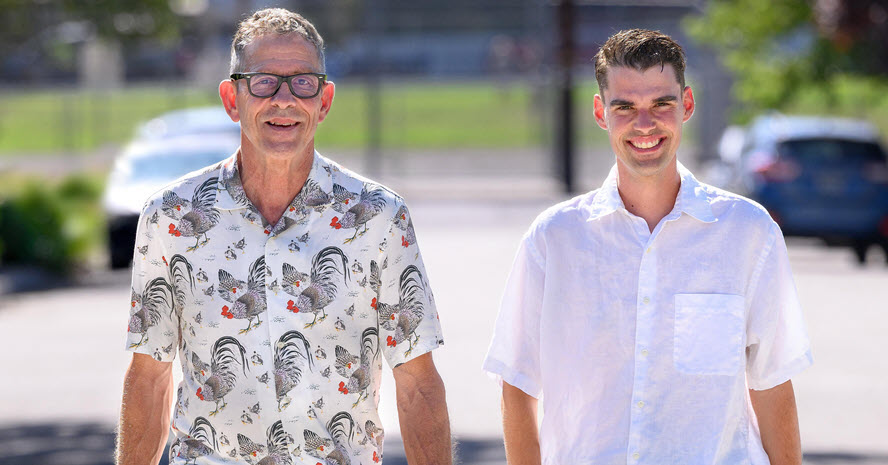
Photo provided by Joe Henry.
Resources
For information on bullying, please see this Child Mind Institute article and watch this SPARK video with Connie Anderson, Ph.D.
References
- Abraham M-R. Newsroom | UCLA BSCRC. Accessed Jan. 12, 2026.
Stay connected with Simons Searchlight
Join our newsletter to receive updates